 : For Students, Faculty, and Staff

My end-of-summer reading included “Time Shelter” by Georgi Gospodinov, a future dystopia about memory and the past, which deservedly won the International Booker Prize in 2023. While Gospodinov is most interested in the more recent past and its political reverberations today, every once in a while he dips into the deep past.
In this excerpt from a chapter titled “Salt,” the author contemplates why [in “old myths (and new ideologies)”] looking back seems to be so dangerous, using the story of Lot’s wife (Genesis 19):
“But what terrible crime has the past committed? Why not look back? Why is the past so dangerous, and why is looking back at it such a sin that you will be turned into a pillar of salt? The apocalypse comes precisely to destroy the past. It’s not enough to leave Sodom and Gomorrah, that’s the easy part, everyone flees from disaster. The real test is to forget it, to wipe it from your memory, to not miss it. Lot’s wife left the city, but couldn’t manage to forget it.
[…]In the Nuremberg Chronicle by Hartmann Schedel from the end of the fifteenth century, there is an illustration of this scene: In the foreground are the father and his daughters, led by a cheerful angel who is chattering to him. They are striding forward, leaving behind the burning Sodom and its collapsing towers. In the middle between the departing group and the burning city stands a woman in white. She has turned her face back. In fact, she is looking slightly off to the side. The past, just like fire, cannot be looked directly in the eye. Her face is peaceful. There is no horror, no fear, no pain. Only salt. While her daughters and old Lot, led by the chattering angel, don’t even notice her absence. They have already forgotten her.”
This poignant passage sent me in search of the image of Lot’s wife in the Bell’s copy of the Nuremberg Chronicle from 1493. This massive and lavishly illustrated book comes from the early days of printing and publishing. It is a history of the world, told in relation to biblical time, and also meant to glorify the city of Nuremberg. The images are stylized and iconic; a young Albrecht Durer was among the artists who worked on the volume.
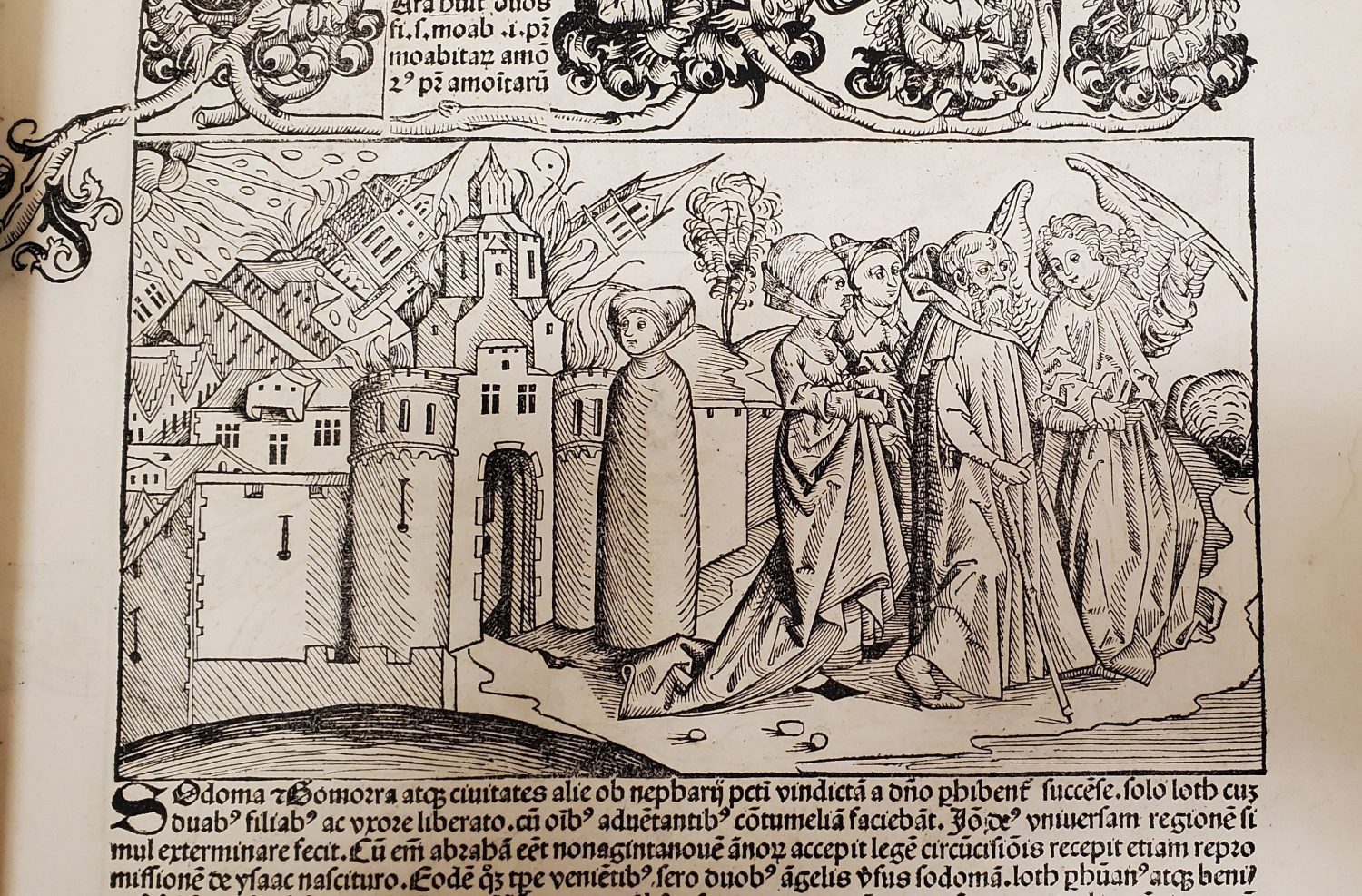
Lot’s wife looks back and is turned into a pillar of salt. From Hartmann Schedel’s Nuremberg Chronicle or Registrum huius operis libri cronicarum cu[m] figuris et ÿmagi[n]bus ab inicio mu[n]di (Nuremberg: Anton Koberger, 1493). Bell Call # 1493 oSc

This is the full page, showing the virtuosity of this book as a printing project.
Gospodinov asks:
“Why salt, exactly?
Because salt has no memory. Nothing grows on salt.”
Though the plot is a little messy, Time Shelter is wonderfully thought-provoking as it engages with historical interpretation, how memory works, and ways that people use the past.
Also, I won’t look at the Nuremberg Chronicle in quite the same way again.