 : For Students, Faculty, and Staff

By Sommer Wagen
By definition, the word “library” denotes the presence of books, and there’s no shortage of them across the University of Minnesota Libraries.
But UMN Libraries, a system of 10 libraries throughout the Twin Cities Campus, offers far more than books — and among their most unique offerings are their innovative spaces: the Toaster, Makerspaces, and Virtual Reality Studio.
These spaces were created to elevate students’ learning experience by creating spaces for practical collaboration and creativity. What’s more, they’re hidden in plain sight, waiting for students to discover what they have to offer.
The Toaster
According to Kimberlie Moock, director of operations at the Toaster Innovation Hub, the airy, 6,500 square foot space in the basement of Walter Library was created because students asked for it.
The Toaster was born from Minnesota Carlson business students wanting a collaborative space to meet students outside of their college with the ultimate goal of creating flourishing businesses.
Business has never been the sole focus of the space, however— Moock called the Toaster “college agnostic.” At its core, it is a hub for entrepreneurship and innovation in all fields.
“At research institutions like the University of Minnesota, students are kind of siloed into their colleges, so a space like this allows for the opportunity for students to mix and mingle in ways they don’t normally have,” she said.
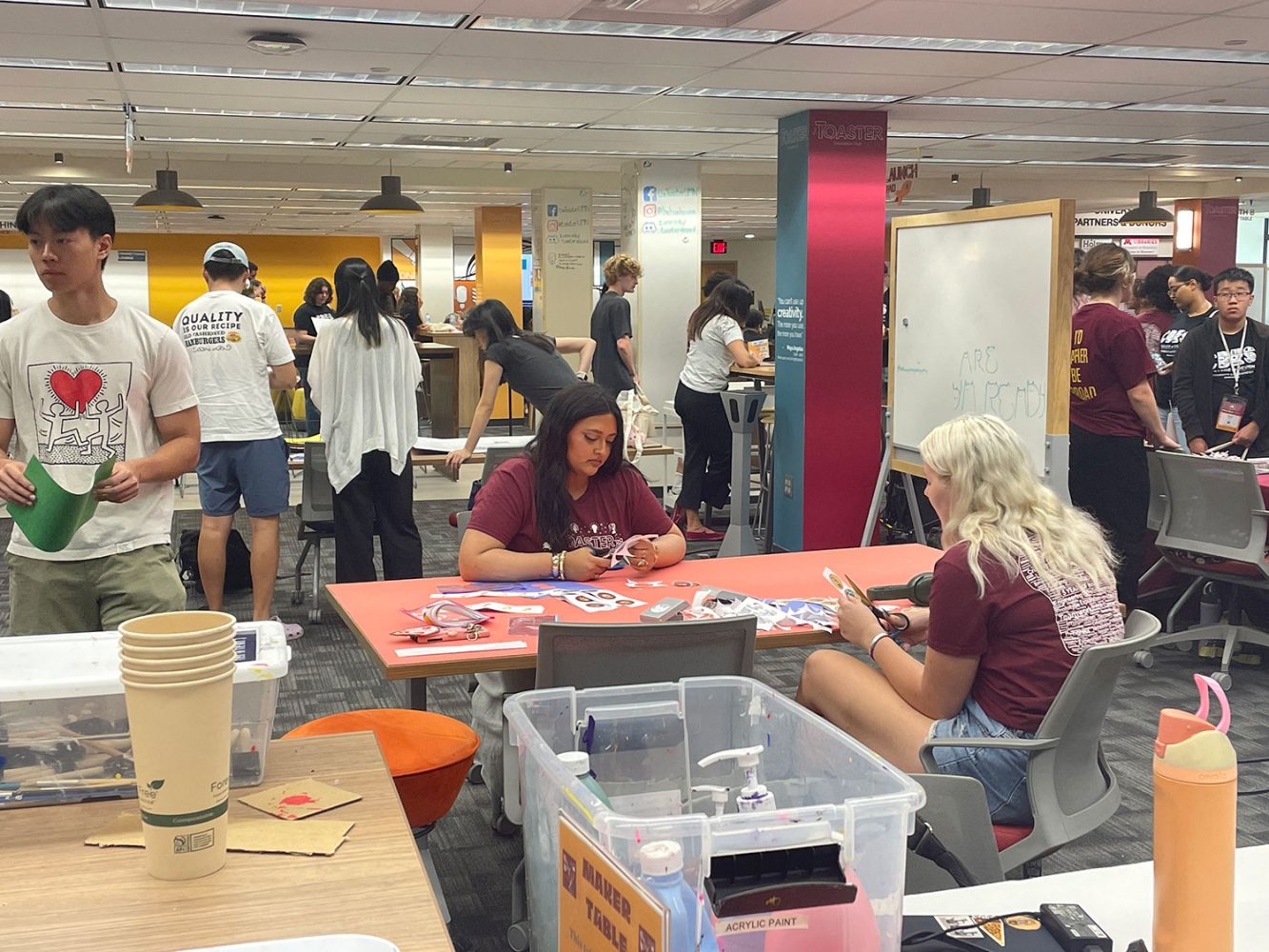
The Toaster’s large space and comfortable, moveable furniture allows for multiple different activities to happen at once (close to 600 across last year alone, according to Moock,) from student group meetings to workshops to students studying or working on a project alone or with friends.

Photo/Adria Carpenter
The knitting and crochet clubs meet at the Toaster, as does the entrepreneurship club. Every semester, The Tinker @ The Toaster challenges students with a new innovation project, with this upcoming semester’s challenge involving game design. The Toaster is open to the general public, meaning anyone can come use the sewing or embroidery machines during their long open hours of 8 a.m. to 10 p.m.
The Toaster’s open concept encourages students to be curious about what’s going on around them, from up close and afar.
“Lurking is totally acceptable,” Moock said.
Opening nearly a century after Walter itself, the Toaster’s bright, contemporary style starkly contrasts the dim opulence of the rest of the library, a visual reminder of its uniqueness and purpose of generating forward momentum. Moock said students take good care of the space— no scratched tabletops or gum to be found underneath them— and are very protective of it.
Photo/Sommer Wagen
“They respect the space because they don’t want it to be taken away,” she said.
With its ability to connect students across a massive campus in one collaborative hub, though, it’s hard to imagine the Toaster going anywhere.
Makerspaces
There is a Makerspace located in the Toaster, but there’s also an expanded space located on the fifth floor of the Health Sciences Library (HSL).
Here, medical students can 3D-print brain scans to physically examine abnormalities, or anyone can come in to quickly repair an item, get creative, or even get started on their Halloween costume.
“Everything is free, so there’s no roadblocks getting in your way,” said Makerspaces manager Steven Bleau. “Once you get a good overview of the space over time, throughout your academic journey, there may be points where you say, ‘I have this idea and I know where to go.’”
The HSL Makerspace consists of four different zones: a primary work zone with four seat tables set for collaboration, a paper crafts room featuring a Cricut machine, a specialty equipment room, and an electronics zone.

Photo/Adria Carpenter
Bleau studied product design as an undergraduate at the University of Minnesota and used the Makerspaces himself. After graduating, he founded a start-up and fabricated his designs primarily at Twin Cities Maker in Minneapolis, a public makerspace. When he returned to the University for graduate school, he wanted a way to contribute to the campus ecosystem, which led him to the manager position.
But you don’t need to be studying product design or medicine to use the HSL Makerspace. You don’t even need to know how to use anything because training is provided for all equipment, and student staff are available to help.
“Being through the libraries, because we’re open to everyone on campus, we don’t prioritize or deprioritize any demographic,” Bleau said.
Bleau said the Makerspaces bridge an accessibility gap between students and technology, providing them with hands-on learning experiences that put their ideas into practice and physical form.
He also highlighted the value in students having a space to relax on campus.
“A good majority of our patrons are just coming in to unwind, fulfill a hobby, learn something new, and just get creative,” he said.
The Makerspace staff recently launched module two of Maker Bootcamp, its open Canvas curriculum taught both in-person and online. It builds off the first module on computer-aided design by teaching students how to design and fabricate a marble maze.
Overall, both Makerspaces are highly versatile hubs for everyone to learn hands-on and build community through creativity.
Virtual Reality Studio
If you ever want to nerd out with someone about the potential of virtual reality, meet VR program lead Charlie Heinz at the Virtual Reality Studio, also located in the Health Sciences Library on the fifth floor of HSEC.
“It’s definitely a place for the curious,” he said.
The Toaster and Makerspaces both have VR technology available, but the VR Studio offers four separate workstations across 900 square feet, as well as nine gaming computers. They also circulate equipment such as cameras and Meta Quest 2 headsets.
Like the HSL Makerspace, because of its location in HSEC, Heinz said medical students use VR to simulate procedures before moving on to physical tests. Several medical school classes use the studio for in-class activities, as well as journalism, art and architecture classes, to name a few.

Photo/Adria Carpenter
You may have even seen the studio in the news for offering an experience by the company Embodied Labs that simulates dying as part of a mortuary science class.
Still, Heinz said students shouldn’t let the technology or its weighty uses intimidate them.
“The reason why I do this is to demystify technology and make it more accessible to a broader group of people,” he said. “We always have staff in the space to help. It’s a very supportive environment.”
Heinz said among the futurists who come to try out the new tech, there are also students who come in to play a game during a study break and people who attend the studio’s meditation workshops.
“We want to support student innovation and creativity, we want to support the whole student, and we want to do outreach to people who are underrepresented in technology fields,” he said. “We can make virtual reality the focus of an event or just the engaging aspect of an event that brings everyone together.”
The VR Studio’s first event of the year is a game night happening on September 9. Heinz also said that he will gladly act as a mentor and consultant to anyone with a project involving virtual reality.
About Sommer Wagen
 Sommer Wagen is a freelance journalist based in the Twin Cities, the traditional and contemporary lands of the Dakota and Ojibwe peoples. They graduated from the University of Minnesota in spring 2025 with their bachelor’s degree in journalism.