 : For Students, Faculty, and Staff

We’re celebrating 2025 with a look back at our favorite stories of the year that feature the innovative, meaningful, fun, and purpose-filled work at the Health Sciences Library and the Wangensteen Historical Library of Biology and Medicine.
This year, we’re going behind the scenes to showcase some of the less visible—but super impactful—work of our exceptional staff.
10. We searched the world to find collections for YOU
Our librarians and curators are actively working to select materials that support broad scholarship. This year, our curators Lois Hendrickson and Emily Beck attended two book fairs, where they had their “most intense shopping experience ever,” talking with over 200 rare book dealers, seeing thousands of amazing books, prints, and artifacts, and spending 10 hour days networking, searching, and researching.
All the while, they were asking important questions, like: Do we have this already? If not, how rare is it? What gap does it fill in the collection? Could we see using it in a class soon? How does it align with researcher interests?
In the end, we acquired a number of exciting new pieces, like 17th and 18th-century public health plague passports (like the Covid vaccine cards!), an early 20th-century intelligence test, and a pamphlet asserting that measles really isn’t that big of a deal (that can be used to link to contemporary conversations).
What didn’t we buy? A first edition of Harry Potter and the Philosopher’s Stone ($225,000), an original pen & ink drawing of Peter Rabbit by Beatrix Potter ($35,000), Copernicus’s De revolutionibus ($2.5 million), and a full set of 18th-century woodblocks for printing tarot cards ($60,000)!
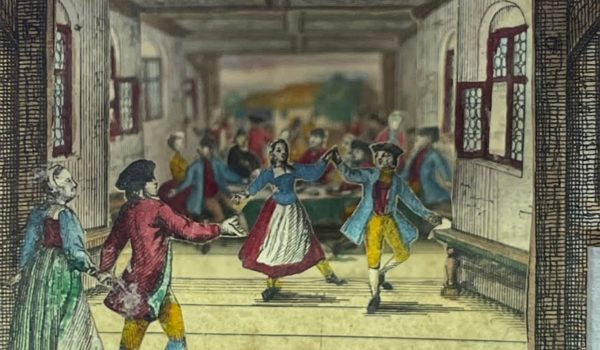
Picture of a rare book taken at a book fair, where curators go on a quest to enrich their collection—amended with practical advice to stay hydrated and wear your most comfortable walking shoes.
9. We partnered to bring new voices to the future of healthcare
We have the privilege of engaging with future health care providers in collaboration with UMN programs. This year, we partnered with the Center of American Indian and Minority Health on a trip to White Earth Nation where we shared our resources and showed how we are bringing innovative approaches to health sciences education. We hope this partnership is long-lasting and that we can help inspire indigenous youth to pursue health sciences studies and careers!
We also partner regularly with Go4Brains, one of our favorite outreach events. Go4Brains is a week-long neuroscience program for high school students from under-served communities. When they visit the Health Sciences Libraries, they stop by the VR Studio to experience different types of neural models, and see early-twentieth-century volumes from works by scholars like Santiago Ramón y Cajal (the father of modern neuroscience).
This year’s engaged group of high school students were able to make insightful connections between the value of historic images. The students specifically spoke about how seeing multiple models of neurons, from historic illustrations to VR models, helped scaffold their learning!
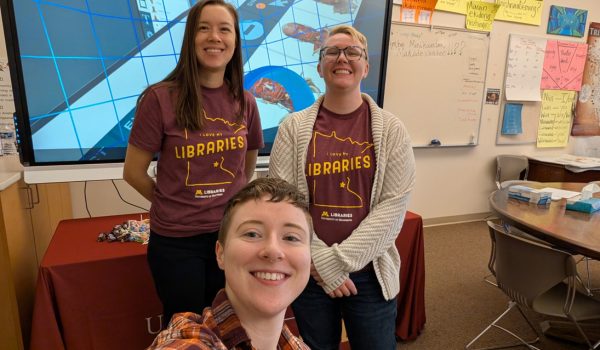
Melissa Ernst, Emerson Ironstone, and Ryn Gagen (top to bottom) visit White Earth Nation to engage indigenous youth in conversations about pursuing health sciences studies and careers.
8. We translated texts for broader scholarship
The Wangensteen Historical Library’s spring pop-up exhibit featured their growing collection of texts from China, Japan, and Korea from as early as the 1600s (with special appearances from the Andersen Horticultural Library and East Asian Library)—including works like Kawahara, K., Kawahara, R., & Japanese Rare Book Collection. (1836). Sōmoku kajitsu shashin zufu (R. Kawahara, Ed.). Maekawa Zenbē (below). It also featured English translations of select texts made possible from an IAS funded grant. These translations set the stage for greater access to these materials for scholars worldwide. They are a first effort towards making translated texts available to broad audiences so scholars at all levels can expand their research beyond the Western lens.
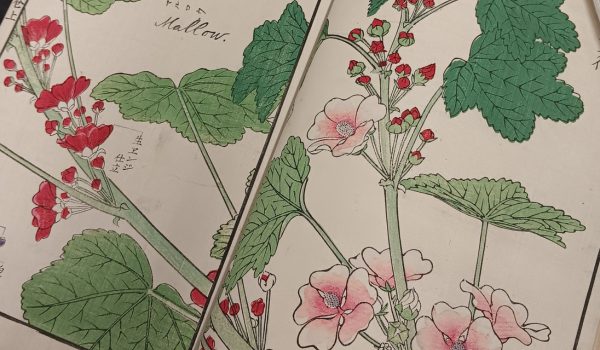
Curators at the Wangensteen Historical Library have been expanding their Chinese, Japanese, and Korean materials, broadening their health related collections beyond the Western lens. Their efforts to translate these texts to English broaden access to these important works.
7. We contributed to the strong future of our health sciences programs
The Health Sciences Libraries collaboration with the health sciences schools and colleges means that we are often asked to support accreditation efforts. Our most recent accreditation request came from Mortuary Science. Ryn Gagen, Nicole Theis-Mahon, Emily Beck, and Lois Hendrickson collaborated on the narrative and the site visit—and they did an amazing job, with commendations in the report to the accreditation agency noting that the library’s collection of current publications, historical collections, and the VR Studio are unique to the university and not found in many other programs. And of course the library staff received accolades for their enthusiastic support for Mortuary Science students, instruction, and research.
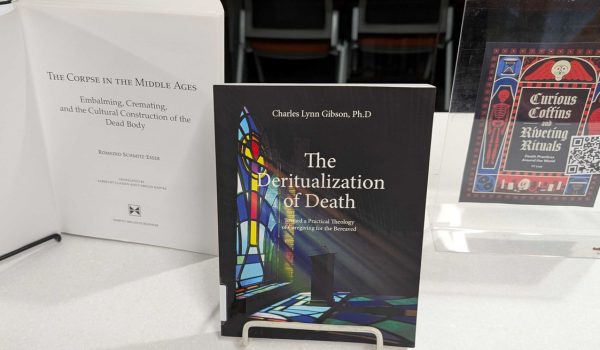
A display of mortuary science texts at the Health Sciences Library accompanies broader efforts to demonstrate the library’s ability to meet the Program of Mortuary Science’s accreditation standards.
6. We opened new ways of learning
Among its noteworthy acquisitions, the Health Sciences Library has a new torso model available for in-library checkout. This model is a human dual-sex model with dark skin tone and 24 parts (including male and female organs) for anatomical study and demonstration. It is hand painted and made of polyvinyl chloride (PVC) plastic. This recent addition provides a nice 3D overview of anatomy and can be a tactical accompaniment to other anatomy resources, such as our VR anatomy headsets.
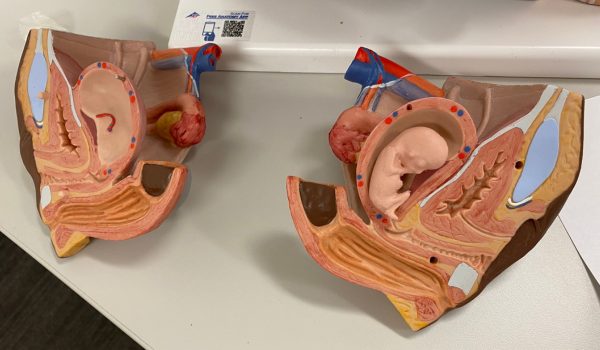
The Health Sciences Library’s new torso model represents one of many new acquisitions that recognize the need for the library to support multiple ways of learning.
5. We mapped plant histories
As a recipient of a Libraries Strategic Initiatives Grant, The Andersen Horticultural and Wangensteen Historical Libraries developed Mapping Plant Histories at the Arboretum. This project places historical texts alongside live plants on the Minnesota Landscape Arboretum grounds. Place-making and storytelling help people create and explore the profound connections between their own lives and the broader world around them.
And now you can enjoy this interactive map of the Arboretum, which informs and inspires viewers with text, video, and photographical information from the two collections by connecting historical knowledge with the living world.
A special shout-out goes to student employees, Ellie Schaefer and Dyllon Lohmann, who researched and designed this interactive map, and who presented their work at the 57th Council on Botanical and Horticultural Libraries Meeting.
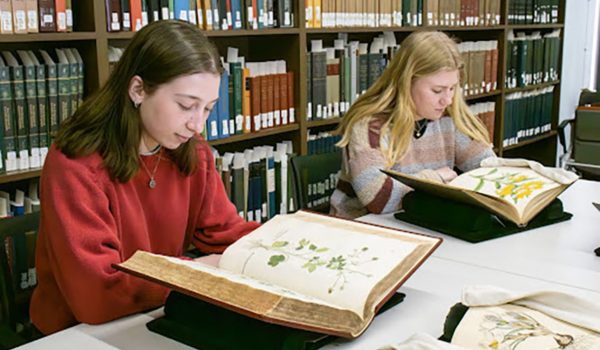
Student employees Ellie Schaefer (left) and Dyllon Lohmann research materials from the Wangensteen collection to incorporate into the interactive map of the Minnesota Landscape Arboretum.
4. We introduced students to making
In August we welcomed the DDS Class of 2029 to the University of Minnesota Dental School. In collaboration with Emerson Ironstone and Steven Bleau, Dentistry Librarian Melissa Ernst co-hosted a series of Makerspace welcome events. Over 50 students explored the Makerspace, made buttons and backpack pulls, printed stickers, and even gave 3D printing a try, all with a goal of lowering barriers to using emerging technologies and encouraging innovation! The hit? Ironstone’s 3D printed tooth beads.
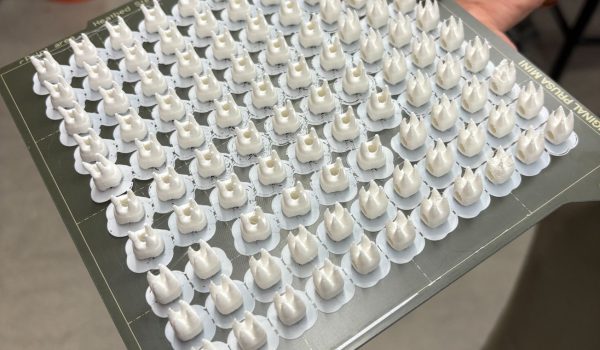
A making day for Dentistry students encourages fun exploration of making technologies, including bracelet-making with the 3D printed molar beads shown here (photo credit: Shannon Gilligan-Wehr).
3. We advanced practice—in health AND information sciences
Our small but mighty crew published 23 articles and gave 19 presentations on a broad range of topics. Our librarians and curators partnered with faculty to publish systematic reviews related to oral health, nutrition, swine biosecurity, diagnostic reasoning, pediatric obesity, and more. Presentations were equally impactful, covering topics such as collaborations across art and sciences, teaching East Asian history, and standardizing guidelines for assessing extracted electronic health records.
We also conducted scholarship to advance health information practice, sharing our research on validating a search hedge for transgender and gender diverse populations, providing multilingual health information, and storytelling with historical documents and artifacts, to name a few. Dentistry Librarian Melissa Ernst’s research on librarian involvement in oral health and systematic reviews won the Excellence in Research: Lightning Talk award at the Midwest Chapter of the Medical Library Association. Hooray!

Librarians and curators at the Health Sciences Libraries engage in broad scholarship on broad topics from swine biosecurity to transgender search hedges and a whole lot of topics in-between.
2. We provided award-winning service
Lois Hendrickson, curator, Wangensteen Historical Library of Biology and Medicine, University Libraries, University of Minnesota Twin Cities, was a 2025 recipient of UMN’s President’s Award for Outstanding Service. Letters of nomination and support speak to Hendrickson’s leadership, mentorship, deep knowledge, collaboration, generosity, and integrity. They describe her as an ambassador of collections, and as someone who has unbounded energy, is forward-thinking, and has an earnest commitment to her work. Across all of these themes, Hendrickson’s portfolio is other-focused, outward-facing, and boundary spanning—three hallmarks of true service.
Nicole Theis-Mahon was the recipient of the 2025 Jean Williams Sayre Innovation Award from Midwest Chapter of the Medical Library Association, recognized by her colleagues for shaping a new generation of health sciences librarians and for creating collections that amplify underrepresented voices.
And of course, the Health Sciences Libraries were home to the three Outstanding Library Student Employee Award recipients, with Dheya Amer, Joseph Stoll, and Dyllon Lohmann honored for their excellence.
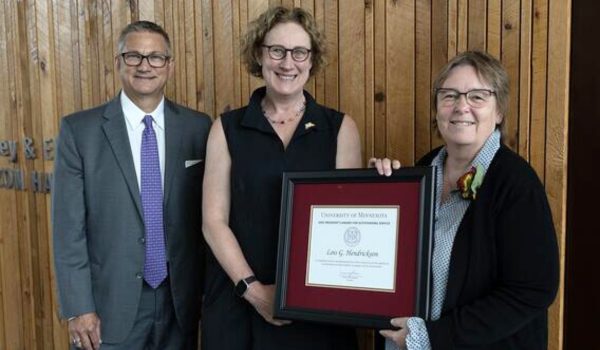
Curator Lois Hendrickson (right) accepts the UMN President’s Award for Outstand Service from President Rebecca Cunningham (middle), and Professor Mark Distefano, chair of the President’s Award for Outstanding Service Committee (left).
1. We had so much fun!!!!
Across all of our meaningful work at the Health Sciences Libraries in 2025, we centered partnership, learning, and belonging as we collaborated to expand conversations around health and healthcare. From all of us to all of you—thank you for a wonderful year!
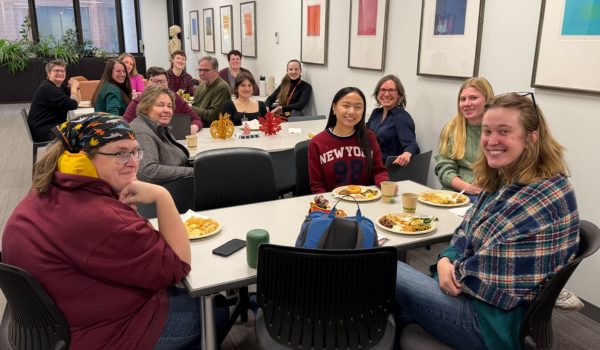
Your colleagues and partners at the Health Sciences Libraries.