 : For Students, Faculty, and Staff

Starting a family in times of political crisis. Changing the bullies who rule the world. Living with an external bladder.
The catalog of women writers at the Upper Midwest Literary Archives (UMLA) runs the full range of the human experience.
“There’s so many things that can strike a chord, even for the most jaded 21-year-old,” said Erin McBrien, UMLA’s curator.
For Women’s History Month and National Poetry Month, McBrien selected 10 women authors from the archives’ collection, each who, in addition to their written contributions, helped create a community of writers where none existed.
UMLA’s collection of women authors surged under McBrien’s predecessor, Cecily Marcus, and then-Assistant Curator Kate Hujda, particularly with female poets affiliated with local organizations like The Loft Literary Center.
Consequently, most of the women in the collection are contemporary authors from the 20th and 21st centuries, and most were not full-time writers. They were freelancers, editors, or held unrelated clerical jobs.
And nearly all were teachers. This was also true of their male peers, McBrien said, but male writers were more likely to hold tenured positions in academia and have grants to fund their work.
With fewer opportunities, women organized and taught community classes, started their own presses and literary magazines, and handled the day-to-day editorial work that often gets overlooked.
“In many ways, women writers are the community,” McBrien said. “It’s women writers and BIPOC writers and queer writers who really create the writing community, because they don’t have the same options as white, male authors.”
Carol Bly
In the 1980 and ‘90s, Bly, a native of Duluth, became a pioneer of nonfiction essays as a literary form. She had a monthly column for Minnesota Monthly, which was later collected into the book, “Letters from the Country,” published in 1981.

Carol Bly’s author photo. Courtesy of the Upper Midwest Literary Archives
Throughout each essay, Bly examined the town of Madison, Minnesota, and how rural life changed during the ‘70s. Her coverage of how rural Minnesotans reacted to President Nixon and the Watergate scandal feels especially resonate today, McBrien said.
In 1996, Bly wrote “Changing the Bully Who Rules the World: Reading and Thinking About Ethics,” another series of essays published by Milkweed Editions, with contributions from authors like Joyce Carol Oates, Alice Walker, Denise Levertov, and more.
The book frames oppressive authorities as “bullies” who use force and intimidation to mandate compliance, and shows how contemporary literature can change this environment by nurturing independent, ethical thinkers.
While readers may know her name or her books, fewer know about her teaching career at Carleton College, Hamline University, the University of Minnesota, and the Vermont Studio Center, said McBrien.
She also published the literary magazines Fifties and Sixties with her then-husband, Robert Bly, created custom crossword puzzles, and was also a member of the board of directors for The Loft in the ‘90s.
“She just did it. She didn’t promote the fact she was doing it,” McBrien said. “I’d like to see Carol get her flowers more.”
Sherry Quan Lee
Lee is a poet, essayist, memoirist, and visual artist, who grew up in South Minneapolis in the ‘60s and ‘70s. Her father was Chinese, and her mother was Black. But Lee and her mother were white-passing. For most of her life, her Black family was hidden from her.

“Chinese Blackbird” by Sherry Quan Lee
“I knew I could be Chinese if I needed to, if I was pressured, according to Mom, but I could not tell anyone I was Black,” Lee wrote for UMLA. Her poetry collection “Chinese Blackbird,” published in 2002, is a moving reflection on her mixed-race heritage, class, gender, and sexuality.
“Her writing is very raw and very, very vulnerable and passionate,” McBrien said. “Culture and ethnicity, what you’re raised as, what you’re viewed as, and how you feel, how do all these things intersect?”
In 2017, Lee edited “How Dare We! Write: a multicultural creative writing discourse,” a collection of 24 multicultural writers talking about how and why they write, and in 2008, she wrote “How to Write a Suicide Note: Serial Essays That Saved a Woman’s Life,” which maps her history with mental health.
Following the trend, Lee freelance for newspapers and did secretarial work, anything to keep her hands in the writing world.
“You see this across all of our female writers,”McBrien said. “They freelanced across different places. They’re often intersectional in different kinds of arts … which is, I think, very revealing.”
Lois McMaster Bujold
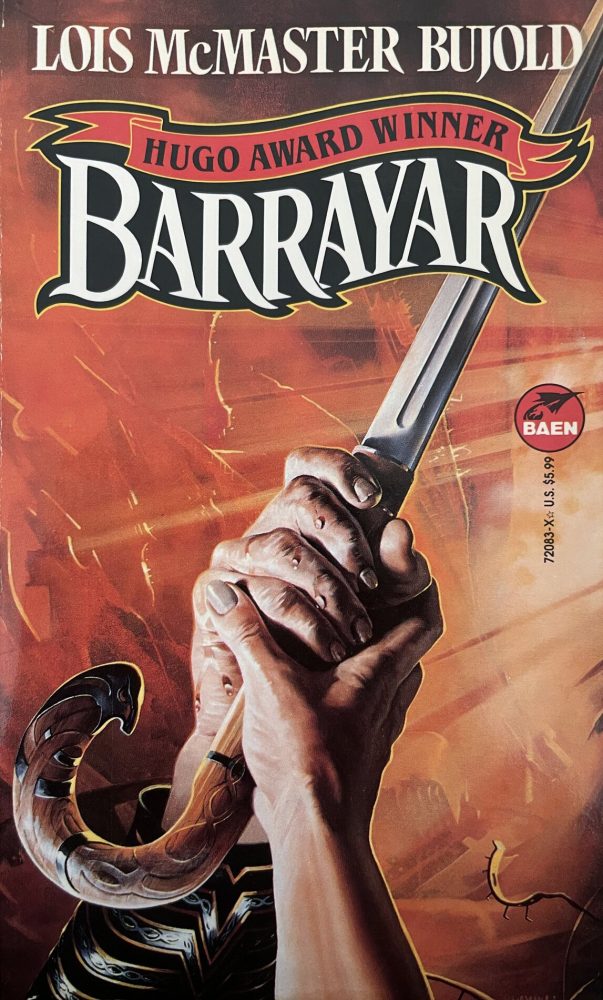
Bujold is a science fiction and fantasy author. She’s tied with Robert Heinlein for the most Hugo Awards for best novel and has won seven Hugo Awards in total, as well as three Nebula Awards. The archives hold her fantasy novella papers and late sci-fi novels.
“Barrayar” by Lois McMaster Bujold
“I love Lois’ papers. I love her books so much. I’m just a big science fiction, fantasy nerd, so it’s really up my alley,” McBrien said.
Bujold is known for two long-running series: the Vorkosigan Saga, a collection of sci-fi novels and short stories, all in a shared universe, and the fantasy series, Word of the Five Gods. McBrien loves authors like Bujold because regardless form or genre, they “interrogate morality and ethics through a very human lens.”
She looks at these grand worlds through the eyes of families and their loved ones, and shows how they’re impacted by the decisions of others. McBrien’s favorite book is from the Vorkosigan Saga, entitled “Barrayar.”
The novel’s protagonist, Cordelia Vorkosigan, lives on a militaristic, patricidal planet called Barrayar, and tries to survive a political coup while protecting her unborn child from assassination attempts.
“I found that book really, really powerful, and it’s one that will probably stay with me for the rest of my life,” McBrien said, though she wouldn’t recommend it to everyone.
Emilie Buchwald
Buchwald is a poet, editor, award-winning children’s book author, and co-founder of Minneapolis-based, nonprofit publisher, Milkweed Editions.
“Transforming a Rape Culture” by Emilie Buchwald
Buchwald was born in Vienna, Austria, in 1935, and her family immigrated to the United States following Kristallnacht, the Night of Broken Glass.
In 1960, she moved to Minneapolis to teach English at the University of Minnesota, where she later earned her doctorate.
Alongside R.W. Scholes, Buchwald founded Milkweed Chronicle, a literature and art journal that ran for 21 issues from 1980 to 1987. During this time, the journal began to morph into the nonprofit literary press we know today, publishing its first book in 1984.
Buchwald retired from Milkweed Editions in 2003, and three years later, she founded The Gryphon Press, an independent publisher of children’s literature that focuses on animal welfare.
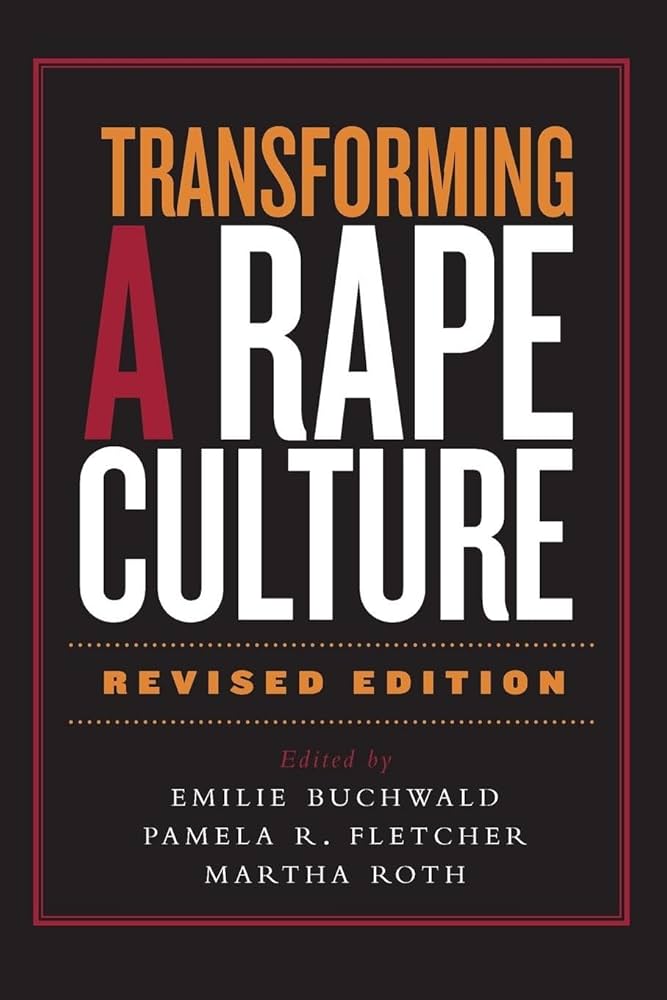
She’s edited several books included 1993’s “Transforming a Rape Culture,” an intersectional examination of sexual violence, 2003’s “Toward a Livable City,” about urban planning and transportation, and the 1991 poetry anthology, “Mixed Voices: Contemporary Poems About Music.”
Deborah Keenan
Keenan, of Bloomington, Minnesota, worked alongside Buchwald as a managing editor at Milkweed Editions for four years. She’s taught poetry at The Loft since 1978 and was a professor at Hamline University for 30 years until her retirement in 2017.

“Willow Room, Green Door” by Deborah Keenan
She’s worked with the Minnesota Writers and Artists in the Schools Program, COMPAS (Community Programs in the Arts and Sciences, and has previously taught at St. John’s University, the University of St. Thomas, and the University of Minnesota.
During her time at Hamline University, Keenan co-founded the Laurel Poetry Collective, a group of 21 poets and two graphic designers.
Keenan has written nine poetry collections, co-edited the poetry anthology “Looking for Home: Women Writing About Exile” with Roseann Lloyd, and has contributed her voice to collections like “Where One Voice Ends Another Begins: 150 Years of Minnesota Poetry” and “American Tensions: Literature of Identity and the Search for Social Justice.”
“Willow Room, Green Door,” published by Milkweed Editions in 2007, collects new and selected poems by Keenan, spanning three decades of her writing career. Her most recent work, “The Saint of Everything,” was released in 2023.
Roseann Lloyd
Like Keenan, Lloyd also taught at The Loft, at COMPAS Writers-and-Artists-in-the-Schools Program for 15 years, at Hamline University and the University of Minnesota as a part-time instructor, and at the University of St. Thomas for 12 years.

“War Baby Express” by Roseann Lloyd
However, Lloyd began her teaching career outside higher education, first at COMPAS, then at Columbia Heights Middle School, the Perpich Center for Arts Education, and Minneapolis Public Schools, before working as an adjunct at Augsburg College and Minneapolis College of Art and Design. In 1991, she co-founded Arts Against Domestic Violence, an advocacy group which helped pass the Violence Against Women Act.
Lloyd published 12 books in her lifetime, five of which were poetry collections. Her second collection, “War Baby Express,” published by Holy Cow! Press in 1996, won the Minnesota Book Award for Poetry.
Like many of her contemporaries, Lloyd wrote non-fiction essays and memoirs in addition to her poetry, and often combined the two, McBrien explained. Her 2012 memoir, “The Boy Who Slept under the Stars: A Memoir in Poetry,” explores her grief and mourning over her brother’s disappearance during a solo hike in Boundary Waters.
“She did both very thoughtfully and deeply,” McBrien said.
Patricia Hampl
Many of the writers on this list had connections with The Loft, and none more so than Hampl. In 1975, she founded the center with Marly Rusoff, Jim Moore, Phebe Hanson, and Michael Dennis Browne.

“A Romantic Education” by Patricia Hampl
Today it’s one of the largest independent writer centers in the country.
Hampl was born in St. Paul in 1946, the daughter of Stan Hampl, a florist, and Mary Hampl, a librarian at Macalester College. After earning her master’s degree at the University of Iowa’s Writers’ Workshop, she became a founding editor of Minnesota Monthly, the same magazine that would publish Carol Bly.
Shortly thereafter, she began teaching at the University of Minnesota’s English Department, and continued until her retirement in 2018 after 37 years.
Hampl started her writing career in poetry, publishing her first book “Woman Before an Aquarium” in 1978, and “Resort and Other Poems” in 1983.
But she’s best known for her work as a memoirist with titles like “A Romantic Education” (1981) and “Virgin Time: In Search of the Contemplative Life” (1992), which explore her Roman Catholic upbringing and her Czech heritage.
n 2007, she released her fifth memoir, “The Florist’s Daughter,” about her mother’s death, caring for her elderly father, and her middle class childhood in St. Paul.
Jill Breckenridge
Breckenridge joined The Loft in 1979 and served as a coordinator for many years, later becoming its director. During her tenure, she launched the center’s nationally renowned Mentor Series, which pairs prominent authors with up-and-coming local authors.

“Civil Blood Poems and Prose” by Jill Breckenridge
She received her bachelor’s degree from the University of Minnesota, her master’s in creative writing from Goddard College, and her master’s in counseling psychology from St. Mary’s College. Outside of the Loft, Breckenridge taught high school English and was a counselor at a community clinic.
In 1971, she helped found The Women Poets of the Twin Cities, a collective that boosted the reputation of women’s poetry and included more women in the literary scene, at a time when local literary events and organizations were controlled and gatekept by men.
Breckenridge published five books in her career, a mix of poetry, short-form prose, and memoir. “Civil Blood: Poems and Prose,” published by Milkweed Editions in 1986, tells the story of John Cabell Breckinridge, the youngest vice president in American history under President James Buchanan, and later the Confederate Secretary of War.
“Miss Priss and the Con Man” is her 2011 memoir about her turbulent childhood with her “charismatic yet wildly unreliable” father, whose fraudulent business practices led to financial disaster and prison time.
“It really showcases a certain sense of humor on the subject of her parents’ marriage,” McBrien said.
Margaret Hasse
Hasse, from Vermillion, South Dakota, is the author of six poetry collections. She currently lives in St. Paul where she teaches and works as an editor and writing mentor, working with many local arts organizations like COMPAS, The Loft, SASE: The Write Place, the Walker Art Center, Perpich Center for Arts Education, and the Minnesota Alliance for Arts in Education.
Hasse’s mother was also a poet and life-long diarist, and her father taught astronomy and mathematics at the University of South Dakota. Her poetry often reflects on what it was like to grow up as a young woman in a conservative landscape during the ‘70s and ‘80s. “Belongings: New and Selected Poems” (2017) complies four decades of poems, taking the reader through her adolescence and into adulthood.
“These are very vibrant, ‘rebellious young woman’ poems,” McBrien said. Like Hasse, McBrien is also from South Dakota, so she gave a copy of the book to her sister.
-

- A poster for a reading with Margaret Hasse and Roy Chester McBride. Courtesy of the Upper Midwest Literary Archives
-

- Margaret Hasse’s author photo. Courtesy of the Upper Midwest Literary Archives
Sandra Benitez
Benitez spent much of her childhood in Mexico and El Salvador, where her father worked as a diplomat for the U.S. State Department, before moving to Missouri to stay with her grandparents.
“Bag Lady” by Sandra Benitez
She attended Northeast Missouri State University (today Truman State University) for her bachelor’s and master’s degrees in literature, and later taught at the high school and university level.
In 1975, Benitez moved to Minneapolis with her husband and two sons, and five years later, began writing at age 39. Her first book, “A Place Where The Sea Remembers,” was published by Coffee House Press in 1993. It won the Minnesota Book Award and was a finalist for the Los Angeles Times book award. Her next novel, “Bitter Grounds,” won a 1998 American Book Award.
Her writing is “extremely moving,” McBrien said, especially to people who live in Central America and whose lives have been shaped by political and sectarian violence.
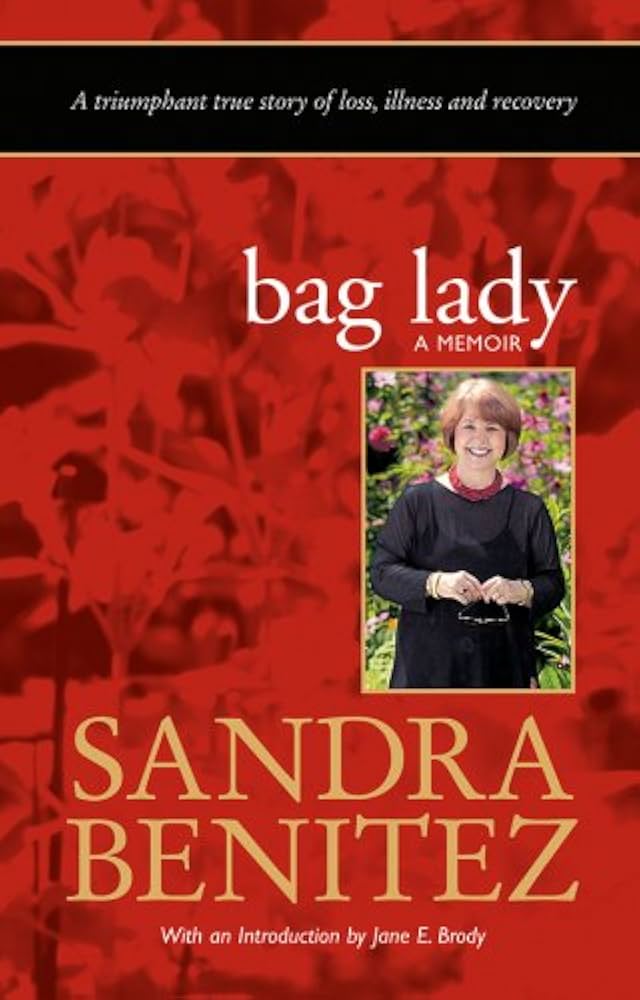
Benitez’ 2005 memoir, “Bag Lady,” chronicles her chronic ulcerative colitis and her decision to have an ileostomy, a surgical procedure that puts a hole in the abdominal wall, allowing waste to exit into an external pouch, which Benitez had to wear for the rest of her life.
“She tackles it with this very tongue-in-cheek sense of humor,” McBrien said.
Benitez was a mentor for the Loft’s Inroads program, held the Knapp Chair in Humanities as associate professor of creative writing at the University of San Diego, and was selected as an Edelstein-Keller Distinguished Writer in Residence at the University of Minnesota.