 : For Students, Faculty, and Staff

For those of you who don’t regularly celebrate International Talk-Like-A-Pirate-Day, here’s a brief description from the awarenessdays.com calendar:
“International Talk Like a Pirate Day is a whimsical and fun-filled holiday that encourages people around the world to unleash their inner pirate by speaking in pirate lingo. Whether you’re a fan of pirate movies, books, or just enjoy a good laugh, this day offers a playful escape from the ordinary as everyone is invited to embrace the spirit of the high seas. From greeting friends with a hearty ‘Ahoy, matey!’ to shouting ‘Arrr!’ at every opportunity, International Talk Like a Pirate Day is all about having fun and spreading joy.”
Surely it is at least a little ironic that piracy and “spreading joy” now go together?
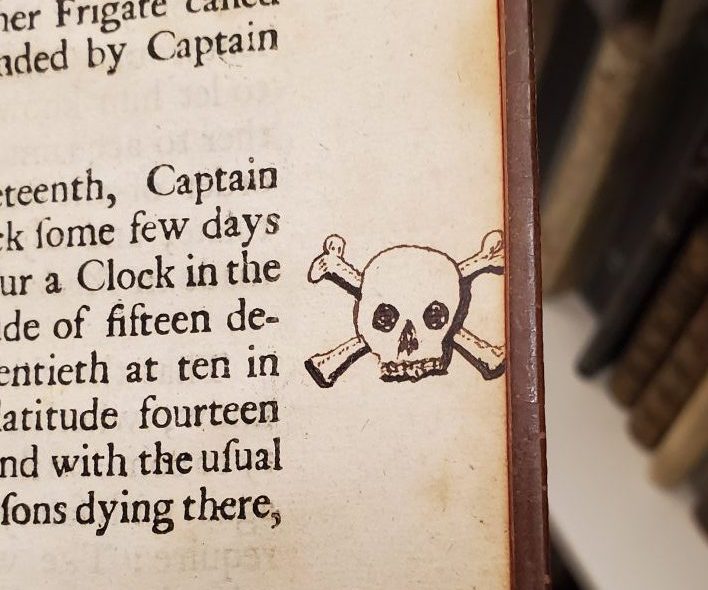
Hundreds of years ago, a previous owner of this book sketched a skull and cross-bones next to the passage describing the death of the pirate Bart Sharp. In Philip Ayres, Juan Perez de Guzman, and William Beeston, The Voyages and Adventures of Capt. Barth. Sharp and Others, in the South Sea : Being a Journal of the Same : Also Capt. Van Horn with His Buccanieres Surprizing of La Vera Cruz : To Which Is Added the True Relation of Sir Henry Morgan His Expedition against the Spaniards in the West-Indies, and His Taking Panama : Together with the President of Panama’s Account of the Same Expedition : Translated out of Spanish (London, 1684). Bell Call # 1684 Ay
I’m pretty sure that my own interest in pirates started with Treasure Island, the Victorian adventure novel by Robert Louis Stevenson, set in the 18th century. It’s been at least 40 years since I read that novel, but I remember that the pirate Long John Silver was the most compelling of characters. My brother and I loved creating treasure maps, wearing eye patches, hoisting our cat to our shoulders to imitate the parrot Captain Flint, stumbling around trying to recreate LJS’s peg leg, and most of all (as it was definitely frowned upon in our house) singing the “Dead Man’s Chest.” It goes like this:
“Fifteen men on the dead man’s chest–
Yo-ho-ho and a bottle of rum!
Drink and the devil had done for the rest–
Yo-ho-ho and a bottle of rum!”
What kid could resist a song like that?!
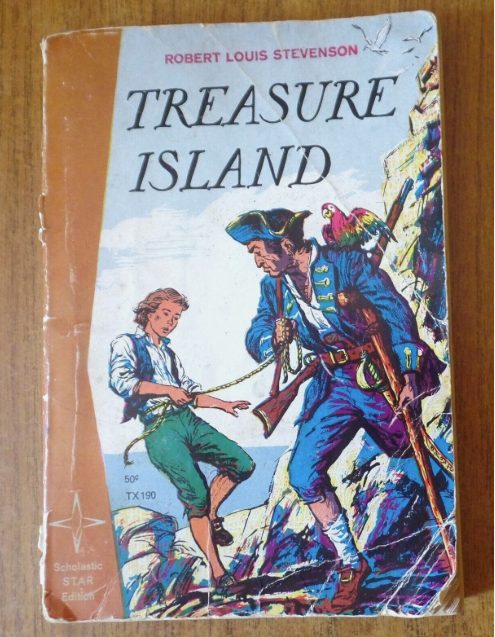
A paperback copy of Treasure Island from 1961, for sale on ebay.
My own children, when little, were subjected to a much softer and more ridiculous piratical hero: Captain Feathersword of Wiggles fame. And later, we discovered the BBC’s program “Horrible Histories,” which included several episodes on pirates. This snippet, on the rules aboard pirate ships, is unexpected and awesome [warning: there is a brief reference to gun violence starting at 2:13 in the clip at this link]: Pirate Rules/Putrid Pirates.
Pirates, privateers, buccaneers, corsairs, and rovers were, of course, real people and major players in premodern trade and violence across the seas and oceans of the world. The Bell has a rich selection of materials for those wishing to study individuals or groups who fell under these labels. These materials include numerous editions, in various languages, of The History of the Pyrates, Containing the Lives of Captain Misson, Captain Bowen, Captain Kidd, Captain Tew, Captain Halsey, Captain White, Captain Condent, Captain Bellamy, Captain Fly, Captain Howard, Captain Lewis, Captain Cornelius, Captain Williams, Captain Burgess, Captain North and Their Several Crews … to the Whole Is Added an Appendix Which Compleats the Lives of the First Volume and Corrects Some Mistakes (London, 1726) – variously attributed to Daniel Defoe and/or Charles Johnson.
Some years ago, a University of Minnesota student created a wonderful online exhibit for the Bell, based on these volumes, that explores the lives of Mary Read and Anne Bonny, two women pirates of the early 18th century. You can find the exhibit here in the Archives and Special Collections Gallery of on-line exhibits. It includes some ideas for lessons for k-12 classrooms based on primary sources about the lives of these two women. Bonny and Read were certainly really interesting characters. Charles Johnson records Anne Bonny’s immortal last words to her lover and captain, the pirate Calico Jack (who was about to be hanged, while she was being sent to prison): “If you had fought like a man you need not have been hang’d like a dog” (Johnson, 133).
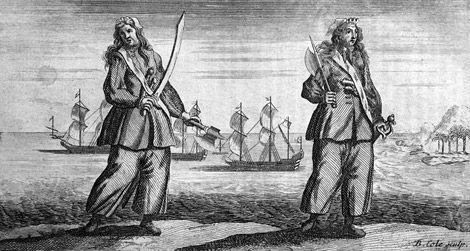
Anne Bonny and Mary Read, two women pirates of who operated in the Caribbean in the early 18th century. Their lives are described in one of the volumes of Johnson & Defoe’s A General History of the Robberies and Murders of the Most Notorious Pyrates, and Also Their Policies, Discipline and Government, from Their First Rise and Settlement in the Island of Providence, in 1717, to the Present Year 1724 : With the Remarkable Actions and Adventures of the Two Female Pyrates, Mary Read and Anne Bonney (London, 1724). Bell Call # 1724 De
Another set of unique materials is from the late 18th century, a “Corsair Archive” of 186 documents originating from St. Malo in France. This collection, which includes example of letters of marque (or official licenses) concerns operations in both the Mediterranean and the Atlantic. It has been digitized in its entirety and is available on the Libraries digital platform, Umedia, at this link.
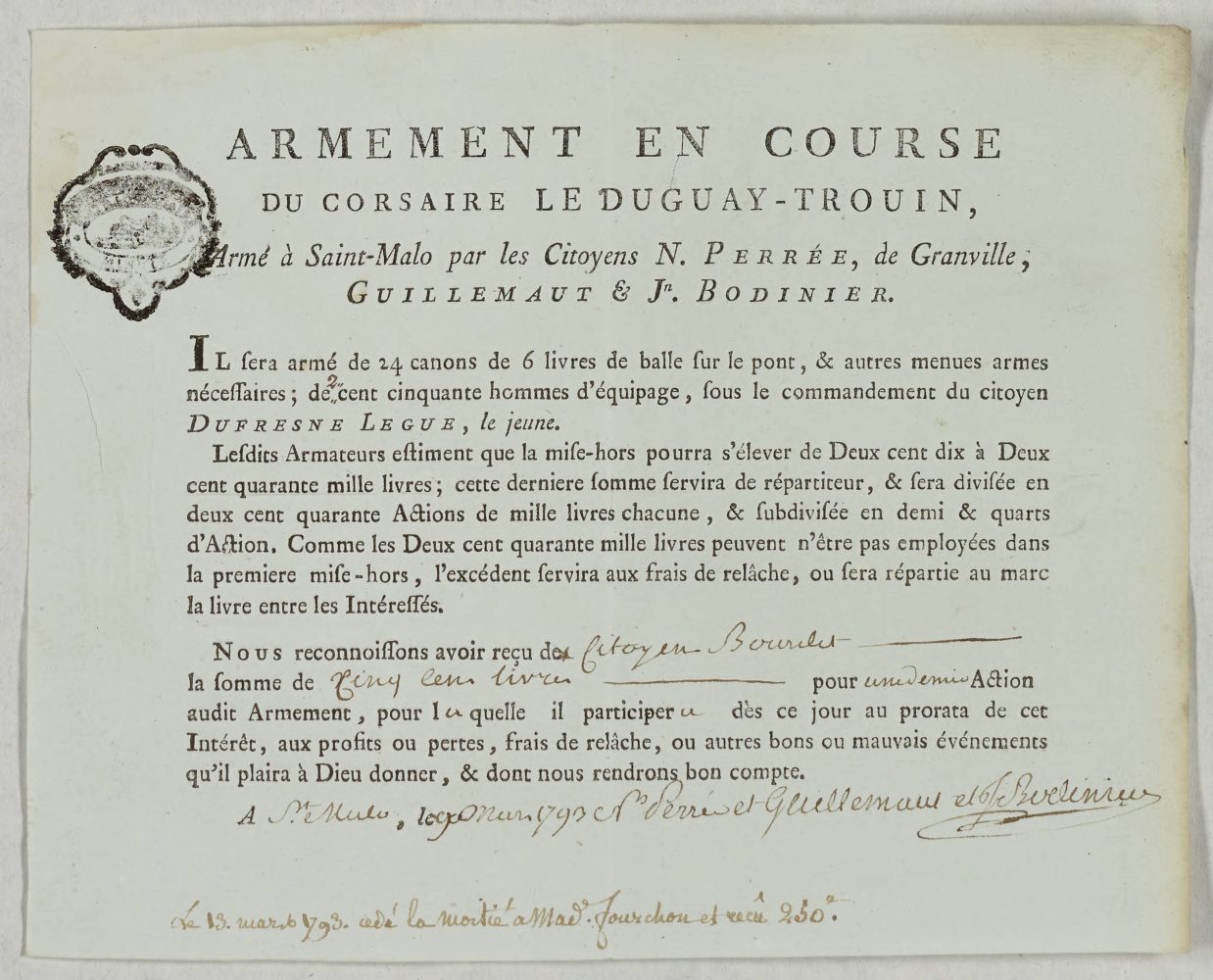
Official document from the Corsair Archive. Bell Call # 1793 fBo
Arrr! Avast me mateys, there’s good research in them there archives!