 : For Students, Faculty, and Staff

Travel narratives written by women in the premodern era are quite rare, and, prior to the 1970s, they were sometimes not collected by rare books libraries because their value was not recognized. The Bell Library also has relatively few of these narratives written by women, but those we have are really interesting, and we are always looking for works to add to the collection. We do have a nice cluster of narratives written by women travelling to Russia and its territories between 1739 and 1841. These are complemented by some additional accounts in Special Collections and Rare Books (SCRB), and together they form a robust set for research and teaching.
These travelling women and their books are not well-known, so I thought it would be interesting to provide short synopses of their lives and work, in roughly chronological order, for this blog post.
[Please click on the images if you would like to see them enlarged.]
1.
Mrs. Vigor (1699-1783), Letters from a Lady, who Resided Some Years in Russia, to Her Friend in England. With Historical Notes (London, 1775).
Though published in 1775, Mrs. Vigor’s book refers to a residence in and near St. Petersburg and Moscow between 1730 and 1733. Mrs. Vigor’s first husband, Thomas Ward, was the British consul-general there until his death in 1731. After that, she married a wealthy and generous courtier, Claudius Rondeau. The appeal of her text lies mainly in Mrs. Vigor’s description of the court of Empress Anna, and especially her accounts of court gossip and intrigue. The historian of women travelers, Jane Robinson, refers to her as “the aptly named Mrs. Vigor!” Her book was quickly translated into French and German during her lifetime.
-

- Mrs. Vigor (1699-1783), Letters from a Lady, who Resided Some Years in Russia, to Her Friend in England. With Historical Notes (London, 1775).
-

- Mrs. Vigor’s table of contents.
-

- Mrs. Vigor getting ready to gossip.
2.
Elizabeth Surby Justice (1703-1752), A Voyage to Russia Describing the Laws, Manners, and Customs of that Great Empire… With Several Entertaining Adventures that Happened in the passage by Sea, and Land … To which is added, translated from the Spanish, A Curious Account of the Relicks, which are exhibited in the Cathedral of Oviedo (York, 1739).
Elizabeth Surby Justice and Mrs. Vigor might have crossed paths in St. Petersburg since it is unclear exactly when the latter left Russia. However, Elizabeth was neither the wife of a consul, nor wealthy. In fact, she traveled to Russia because her former husband refused to pay her an annuity, even after she sued him. Lacking all funds, she decided that the best course was to leave her own children in England and travel to Russia to act as the chaperone of an English family there. Jane Robinson calls this book “a delightfully unprofessional account of a Wronged Woman’s journey to Russia.” She left England in 1734 and took up residence in St. Petersburg, and her account details the social life and customs of the Russians she met and interacted with there. By 1737 she was back in England. There she found that her financial woes were not over; indeed her former husband had been arrested and found guilty of stealing perhaps 100s of books from the Libraries of Cambridge University. So Elizabeth wrote this book and published it by subscription in order to raise funds. According to Matthew Lyons, “It is the first book of travel writing by a woman to be published in English.” Rather bizarrely, after her travel narrative, a completely unrelated, translated, description of the relics at the cathedral of Oviedo is tacked on, which includes woodcuts. It would be interesting to trace the provenance of this description to try to figure out why Elizabeth thought this might lend value to her text for her subscribers.
-

- Elizabeth Surby Justice (1703-1752), A Voyage to Russia Describing the Laws, Manners, and Customs of that Great Empire… (York, 1739).
-

- Elizabeth’s “signature” at the end of the preface.
-

- Several pages of subscribers follow the preface.
-

- The journal ends in melancholy verse.
-

- Oddly, Elizabeth tacks on a completely unrelated translation of the list of relics found in the cathedral of Oviedo.
3.
Elizabeth Craven (1750-1828), A Journey through the Crimea to Constantinople (London, 1789).
Elizabeth Berkeley – also known as Lady Craven, and later Margravine of Brandenburg, Anspach, and Bayreuth, Princess Berkeley of the Holy Roman Empire – was an adventurous and exceedingly confident woman. Scholars who wrote about her, even in the 1990s, tended to take on a moralizing tone when describing her life because, in her time period, her actions were considered scandalous, though not enough to do her any real harm. Now her life and works (including several plays and songs) are usually interpreted in the light of Enlightenment feminism. At the age of 16, at her mother’s wish, she was married to William, 6th Baron Craven, who was 12 years older than her. They shared a tumultuous alliance for 16 years that resulted in seven children and several affairs on either side. After their separation, in 1782, Elizabeth decided to travel. She visited most of the countries of Europe and had a great time partying at royal courts, as well as traveling side-saddle on her own. She met the Margrave of Anspach-Bayreuth, a top-tier German nobleman, during her travels, and presumably the two fell in love, as she eventually married him in 1791, after the deaths of both their spouses. They returned to England where they invested in estates and bred horses, until the Margrave’s death in 1806. Then Elizabeth returned to traveling on the continent until she settled at a villa near Naples, where she died in 1828. Her book, A Journey through the Crimea to Constantinople, is narrated as a series of letters addressed to the Margrave. In addition to commentary on travel and places visited, Elizabeth includes numerous details regarding women she met or observed, such as their dress, accessories, servants and even topics of conversation.
Special Collections and Rare Books at the University of Minnesota Libraries also has copies of Elizabeth Craven’s plays, The Baron Kinkvervankotsdorsprakingatchdern (1781) and Airs and Chorusses in the Princess of Georgia : An Opera (1798).
-

- Elizabeth Craven (1750-1828), A Journey through the Crimea to Constantinople (London, 1789).
-

- Elizabeth’s observations about the Vaucluse cavern in southern France – Enlightenment subtlety.
-

- Elizabeth was the first woman to descend into the Antiparos caves in Greece — or at least the first woman to write about the experience.
-

- Image in: The Copper Plate Magazine, volume 3 (1792).
-

- Benham was built by William Craven and he and Elizabeth lived there during their marriage. Later, the Margrave of Anspach-Bayreuth bought the estate, and it was one of the places where he and Elizabeth lived in England.
-

- A previous owner of this volume glued in a notice from 1806 announcing the death of the Margrave.
4.
Maria Guthrie (died c. 1800), A Tour Performed in the Years 1795-6, through the Taurida, or Crimea, The Ancient Kingdom of Bosphorus … and all the other countries on the North Shore of the Euxine … Described in a series of Letters to her Husband, the Editor (London, 1802).
Maria Guthrie (born Marie de Romaud-Servesnes in Burgundy) most likely settled in St. Petersburg some time in the 1760s or 1770s with her first husband, known only as “N. Dunant.” She became the Acting Director of the Imperial Convent for the Education of the Female Nobility of Russia in the 1770s, and, after the death of Mr. Dunant, married the Scottish physician Matthew Guthrie (1743-1807), who was the doctor for the Cadet Corps of Nobles and a Councillor of State to Czar Paul. He was a man of many interests – scientific, medical, antiquarian, ethnological, musical, geographical, and more – who also kept up an extensive correspondence with like-minded men all over Europe. Maria’s “tour,” starting from St. Petersburg and heading to the warmer climate on the coasts of the Black Sea, started in 1795, for the purpose of restoring her health. She traveled with a woman servant and was accompanied by the German naturalist Peter Simon Pallas and his family. (Pallas’s works are also among the treasures of the Bell collection). The journey was, in fact, grueling, but Maria kept up with her husband’s wish that she report on all of the ancient ruins (especially Greek and Roman) that she saw, as well as keeping notes for their shared interests in botany, ethnology, and history. She wrote with the understanding that her letters and notes would form the basis for a published account in collaboration with her husband. She wrote in French, and so Matthew Guthrie eventually both translated and edited her work, weaving in observations of his own. Maria died in 1800, and this work was published posthumously.
-

- Maria Guthrie (died c. 1800), A Tour Performed in the Years 1795-6, through the Taurida, or Crimea, The Ancient Kingdom of Bosphorus … (London, 1802).
-

- Maria’s narrative includes a detailed map of the Crimean peninsula and part of the coast of the Black Sea.
-

- Maria and her husband were particularly interested in the remains of Classical antiquity in the Black Sea region.
-
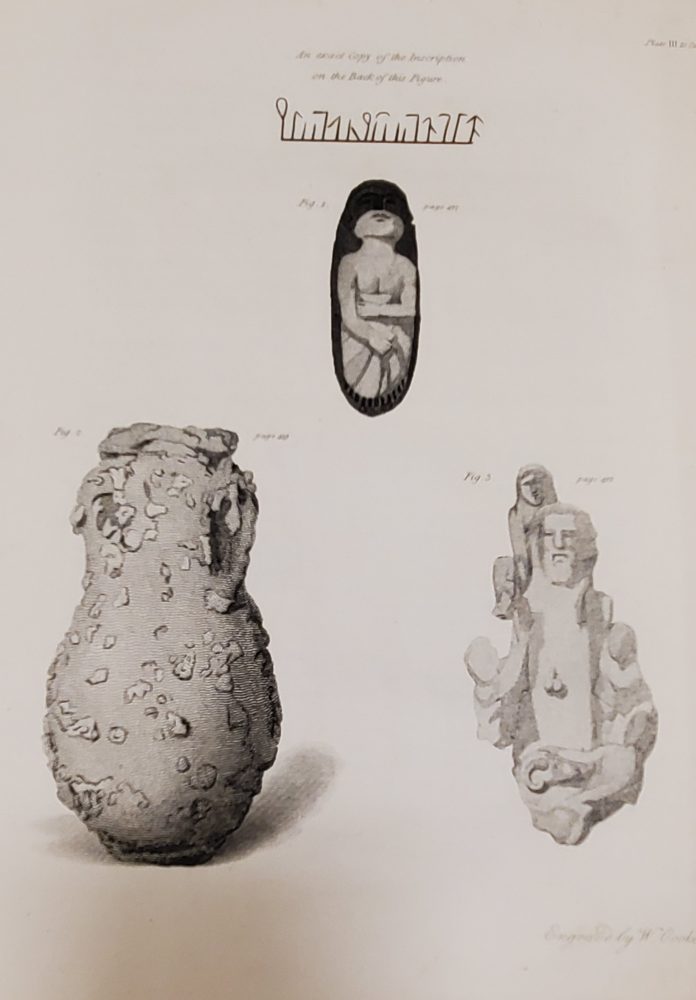
- Odd little archaeological finds along the way.
5.
Sophie Cottin (née Risteau) (1773-1807), Elizabeth, or, The Exiles of Siberia : A Tale Founded upon Facts (London, 1817); also a later edition: Elizabeth, or The Exiles of Siberia (Glasgow, 1851).
Sophie Risteau was brought up in Bordeaux and received an excellent artistic and literary education. At age 17, she married a wealthy Parisian banker, but after he was killed in the Revolution, she began writing romances and adventure stories. Her last novel, Elizabeth, or, The Exiles of Siberia (first published in French in 1806), is not a first-hand travel narrative as such, but it does describe a grueling journey from Siberia to St. Petersburg made by a young woman to plead for a pardon for her father. Sophie was a follower of Jean Jacques Rousseau and her writing reflects his ideas about education and morality. The novel was very successful, being translated and re-published at least 12 times in the course of the 19th century.
-

- Elizabeth, or, The Exiles of Siberia : A Tale Founded upon Facts (London, 1817).


6.
Mary Holderness (fl. 1815-1828), New Russia. Journey from Riga to the Crimea by way of Kiev; with some account of the Colonization, and the Manners and Customs of the Colonists of New Russia. To which are added, Notes relating to the Crim Tatars (London, 1823).
Very little is known about Mary Holderness herself, and that is because she was an ordinary person. Most likely she and her husband were farmers, albeit educated ones, which was more common in the 19th century than previously. In 1815, they signed up to travel to the Crimea to farm a parcel of land that was part of a larger estate purchased by the Rev. Arthur Young (son of the well-known agriculturalist Arthur Young [1741-1820]). The Holdernesses traveled with four children, including an infant who was less than 2 months old. They sailed from Gravesend to Riga (Latvia); then traveled south, overland, to the Crimea – a journey which took a month and a half. They lived there for about four years before returning to England. It is unclear whether Mr. Holderness had died before they left, but Mary published her book just three years later to help support herself and six children, at which time she was described as a widow. Her book provides a great deal of information about the peoples of the land we would call Ukraine, and especially about the Tatars of the Crimea, but she tells us almost nothing about herself.
-

- Mary Holderness (fl. 1815-1828), New Russia. Journey from Riga to the Crimea by way of Kiev… (London, 1823).
-

- A rather grand image of the Tartarian bath house.
7.
Anne (1795-1855) and Charlotte Disbrowe (dates unknown), Original Letters from Russia 1825 – 1828 (London, 1878).
Charlotte Disbrowe was the oldest daughter of Anne Disbrowe and her husband Colonel Edward Disbrowe, a career diplomat who was named Minister Plenipotentiary and Envoy Extraordinary, first to the court of Tsar Alexander I (d. 1825) in St. Petersburg and then to the court of Nicolas I (d. 1855) in Moscow. The Disbrowes were in Russia for three years and also traveled to Finland during that time, an experience described in Anne’s letters. Anne’s letters are conversational and packed with personal observations about the royal court in Russia during tumultuous times. Charlotte published her mother’s letters privately and posthumously. Only 90 copies were printed by The Ladies Printing Press “for the Tuition and Employment of Necessitous Gentlewomen,” so it is exciting that we have a copy here in Minnesota!
-

- Anne (1795-1855) and Charlotte Disbrowe (dates unknown), Original Letters from Russia 1825 – 1828 (London, 1878).
-

- I wonder if the original album has survived somewhere?
-

- The Ladies Printing Press “for the Tuition and Employment of Necessitous Gentlewomen.”
8.
Elizabeth Eastlake (née Rigby), A Residence on the Shores of the Baltic. Described in a Series of Letters (London, 1841).
Elizabeth Rigby was 29 and not yet married when she travelled to Reval on the Baltic coast of Estonia to visit her married sister there. She traveled by sled, in the depths of winter, with just a Russian manservant. Her book describes the people and places she encountered on the journey through Imperial Russia. According to Jane Robinson, Eastlake’s work is “unusually well crafted, sensitive, intellectual, and finely illustrated with the author’s own sketches.” In 1845 she also wrote a now rather famous article about “Lady Travelers,” which explained why their travel narratives were superior to those of men: “The gentleman’s [are] either dull or matter-of-fact, or off-hand and superficial … while the lady’s all ease, animation, vivacity, with the tact to dwell upon what you most want to know, and the sense to pass over what she does not know herself.”

Elizabeth Eastlake (née Rigby), A Residence on the Shores of the Baltic. Described in a Series of Letters (London, 1841).

Engraving of Elizabeth’s sketch of Reval.
Further Reading
Brian Dolan, Ladies of the Grand Tour. British Women in Pursuit of Enlightenment and Adventure in Eighteenth-Century Europe (New York, 2001).
Wolfgang Griep and Annegret Pelz, Frauen reisen. Ein bibliographisches Verzeichnis deutschsprachiger Frauenreisen 1700 bis 1810 (Bremen, 1995).
Barbara Hodgson, No Place for a Lady: Tales of Adventurous Women Travelers (Berkeley, 2002).
Jane Robinson, Wayward Women: A Guide to Women Travelers (Oxford, 1990).